On this page, you can a breakdown of the branches and ranks of the Armed Forces and a combat chronicle for all of the veterans in the show.
The Armed Forces

Overview
The Armed Forces consist of 6 branches: The Army, Marines Corps, Navy, Air Force, Space Force, and Coast Guard. Each branch has its role and domain. The Army has land, Marine Corps and Navy have sea (with the Navy strictly maritime operations and Marines amphibious operations). The Air Force in air operations, the Space Force in space operations, and the Coast Guard also on maritime operations as well as law enforcement.
For our purposes, we will be looking at the Army, Marine Corps, and Navy. Each member of the Donny Nova Band served in one of these branches and had their own rank and combat history within them.
On this page, you can find a breakdown of military ranks and a more detailed picture of what each member of the band may have gone through during their service based on the info in the script.
Donny Novitski
Full Title: Private First Class in the Army National Guard's 37th Infantry Division.
Branch: The Army National Guard (the reserves of the U.S. Army).
Rank: Private First Class (just above the introductory rank given to all army members). This rank is obtained after about a year of service.
Division: the 37th Infantry Division was a unit of the Army in WWI and WWII. It was a National Guard division from Ohio, nicknamed the "Buckeye Division".
Service: This group started federal service in October 1940, went overseas for the campaigns Northern Solomons and Battle of Luzon, and returned in November 1945.
Campaign Info: The Solomon Islands campaign was a major campaign in the Pacific Theatre of WWII with fighting mainly between Japanese and Allied powers of the U.S, Australia, New Zealand, and the U.K. The battles occurred in several islands including New Guinea, Guadalcanal, New Georgia, and Bougainville.
Effects of the War: The script alludes to severe PTSD symptoms such as insomnia, flashbacks, and general guilt from the friendly fire incident.
and Michael Trojan
Combat Chronicle
-
Arrived in Fiji in June 1942 to fortify the islands against possible invasion and finish training which they continued on Guadalcanal in April 1943 when fighting between other U.S. troops and Japan ended there.
-
They assisted the Marine Raiders in New Georgia taking Munda airfield in July through September 1943 and spent the month after attempting to rest
-
The next assignment was Bougainville. In November 1943 the division expanded the western beachhead sector, constructed roads and bridges, and carried out extensive patrolling.
-
In March 1944 two Japanese divisions made eight major attacks but they were cleared
-
They remained to train for the Luzon campaign landing on the Lingayen Gulf beaches in January 1945 and racing inland toward Manila through various small battles.
-
Upon the Pasig River, the U.S. and Japanese troops ran into each other and through heavy street fighting cleared the city by March
-
After garrison duty for the rest of March, the division went to the hills of Luzon where fighting culminated in the capture of Baguio in April aided by Filipino troops.
-
They were rehabilitated during May, followed by an action in June in the Cagayan Valley which further deteriorated Japanese resistance. With the end of hostilities, they returned in 1945 for the States to demobilize.


Wayne Wright


Full Title: First or Second Lieutenant of the U.S. Marine Corps.
Branch: The United States Marines Corps specializes in amphibious operations but also fights in land campaigns alongside the Army. They often protect US embassies around the world including defending and seizing naval bases. They may also have duties such as flying planes, driving armored vehicles, and more. They are often the first forces deployed during conflicts.
Rank/Service:
While we do not know how long Wayne specifically served, we do know that he was a Lieutenant. To become a Lieutenant soldier complete The U.S. Marine Corps Office Candidates School (OCS) which trains, screens, and evaluates potential officers. Those who complete are commissioned as Second Lieutenants and can later move up to First Lieutenant, and even further into the officer ranks. There are very few routes to becoming a Lieutenant other than this.
-
The course was first offered in 1891 and likely evolved but to get at least some idea, the training as it is today is either a 10-week or two 6-week courses over separate summers that evaluate candidates by placing them in leadership positions in stressful environments (the 10 week course only happens after junior year of college). Entry to the school comes from several programs such as the Officer Candidates Course, Platoon Leaders Class, NROTC (Marine Option), and more. This means strict marine training and leadership testing were a LARGE part of Wayne’s life from college age through the war.
Combat Chronicle
-
While it is not clear if Wayne and and any soldiers he was an officer for were stationed anywhere specific we can use his title to learn more about what daily life may have looked like.
-
You can think of Lieutenant almost like middle management. The general and other higher-up officers create an attack or defense plan and Lieutenants carry out those plans with their units. This can be a Platoon (about 20-50 soldiers), Company/Battery/Troop (60-200 soldiers), or Batallion (300-1000 soldiers) depending on Lieutenant rank (Second, First, and Lieutenant Colonel in order).
-
The job pays much nicer because it is an officer position but does not come without downsides. Lieutenants must be strict, think on their feet, and keep in mind the lives of often hundreds of men. The title can mean both the burden of responsibility when something goes wrong and the guilt if soldiers are harmed.
Division: No information.
Campaign Info: No information.
Effects of the War: Marines are meant to be some of the toughest military members, so it makes sense how he isolates himself and keeps organized like the leader he was meant to be. We see a few scenes depicting how he may have ruled by example, perfectly methodically cleaning his gun like he was supposed to. Symptoms of PTSD seem to include OCD, ritual gun cleaning, and possibly suicide ideation.
Jimmy Campbell
Full Title: Unknown Rank in the United States Navy Serving on the USS Reid 369.
Branch: The United States Navy.
Rank/Service: While we are not told how long Jimmy served and what his rank was, by the time he was likely on the USS Reid he may have ranked up from Seaman to a Petty Officer.
Division/Campaign Info: Served on the USS Reid (DD-369). A Mahan-class destroyer patrolling off Leyte in the Philippine Islands. Participated in training and fleet maneuvers in the Atlantic and Pacific (see more info to the right.)
Effects of the War: While we do not see many specific PTSD symptoms in Jimmy, it is clear that he protects himself by keeping a wall up and continuing to fight injustice through the start of his law career.
Note: The Navy has been historically stereotyped to be the "gay" branch of the military. While it is not very clear, Jimmy's character seems to be meant as a representation of gay military members who could not reveal their identity. His law career is a way to fight for progress while keeping his identity a secret for safety.
Combat Chronicle
-
USS Reid (DD-369) was a Mahan-class destroyer. Destroyers are long-endurance warships used to escort larger vessels in a fleet and defend them against threats This class of destroyers was improved from the previous in many ways including more torpedo tubes, superimposed gun shelters, and generators for emergency use.
-
Reid was launched in January 1936 and participated in training and fleet maneuvers in the Atlantic and Pacific between 1937 and 1941.
-
During the attack on Pearl Harbor (December 1941) Reid’s gunners fired at the Japanese planes and downed one of them.
-
Afterward, Reid patrolled the Hawaiian Islands and escorted a convoy to San Francisco in January 1942. She returned to Hawaii for more patrol before escorting two more convoys from Pearl Harbor to San Francisco.
-
Departing from Pearl Harbor in May 1942, Reid supported a battle off of Alaska. Supported landings, sank a Japanese submarine, and transferred five prisoners. Afterward, she returned to Pearl Harbor to escort multiple task groups to various locations.
-
Upon leaving Fiji on Christmas day 1942 she escorted Army troupes to Guadalcanal (Donny may have been escorted on this trip). She bombarded several enemy locations there.
-
After patrolling in the Solomon Islands Reid assisted landing in New Guinea in September 1943.
-
She aided more landings around the islands of the Pacific Theatre throughout 1944. In the later months of 1944 She patrolled off Leyte, Philippine Islands where the ship would eventually meet its end.
-
In Reid’s final two weeks, they were called to battle stations aabout 10 times a day, meaning near-constant combat for the sailors onboard. In December 1944 Reid destroyed seven Japanese planes while protecting a re-supply force of amphibious craft bound for Ormoc Bay off the west coast of Leyte.
-
Reid was the nearest ship to oncoming planes reaching the convoy on December 11th. Multiple planes bombed the ship in the course of a minute.
-
The ship was mortally wounded and went down in less than 2 minutes. 103 crewmen went down with the ship and the survivors were strafed (attacked with bombs or machine gun fire from the aircraft) in the water before 150 were rescued. The ship received seven battle stars for WWII service.


Johnny Simpson
Full Title: Private in the United States Army
Branch: The United States Army
Rank/Service: Johnny is an Army Private. It is not indicated that he is a second or first class Private meaning he may have only been out of BootCamp for a few months before going home.
Division/Campaign Info: No Information
Effects of the War: Johnny may not have many obvious psychological effects from the war but he has much physical pain in his back and head. Despite 3 operations (which were likely expensive) his pain has not ceased causing a consistent need for pain medication. He also has issues with mental clarity and thinks a little slower than before the war.

Combat Chronicle
-
The script does not reveal much about Johnny's time in combat including information about where he was.
-
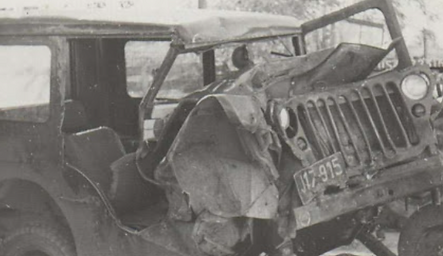
We do know that while away Johnny was in a Jeep that was hit by a shell (projectile from a gun or warship). The Jeep flipped 3 times as he drove. This resulted in 3 operations on his back and a constant need for pain medication.
Davy Zlatic
Full Title: Unknown Rank in the United States Army.
Branch: The United States Army
Rank/Service: We are not told how long Davy served or his rank. No indication likely means he is a Private (the basic rank after BootCamp)
Division/Campaign Info: The troops that liberated Dachau were the 42nd Infantry Division, the 45th Infantry Division, and the 20th Armored Division. The 45th is the Oklahoma National Guard and the 20th Armored mainly assisted through weapons provision. We are not explicitly told Davy's division but due to these reasons, it is more likely Davy was in the 42nd division. The 42nd was nicknamed the Rainbow Division for having so many soldiers from across many states.
Effects of the War: Davy is an alcoholic, using his habit as self-destructive behavior (a symptom of PTSD). He seems to use humor to cope after having seen the horrors at Dachau.


Combat Chronicle
-
The Rainbow Division was activated into WWII service in July 1943. Following training in Oklahoma and the journey to Europe, they arrived in France in December 1944 and were formed into Task Force (TF) Linden. They entered combat in the vicinity of Strasbourg.
-
While defending along the Rhine north and south of Strasbourg in January the TF Linden fought off multiple enemy counterattacks.
-
After these enemy attacks, TF Linden returned to the reserve of the 7th army and trained more.
-
In Febuary1945 they reentered combat occupying a defensive position near Haguenau.
-
Eventually, they transitioned to offensive, and German soldiers came to fear their patrols and raids. They moved across the Rhine capturing multiple areas in fierce battles.
-
On April 25th the team captured Donauwörth on the Danube. On April 29th the 42nd Division liberated some 30,000 inmates at Dachau concentration camp and arrested German officers and war criminals.
-
Dachau was liberated by the 42nd and 45th Divisions and the 20th Armored Division. There were about 32,000 prisoners there at the time despite 67,665 having been registered. Many were “political prisoners” and/or Jews. The Germans had just sent more than 7,000 prisoners on a death march to Tegernsee. The soldiers librated those at the camp as well as those sent on the march.
-
Dachau was one of the first concentration camps built by Nazy Germany and the longest-running one, opening in March 1933. The camp system grew to include nearly 100 sub-camps. The complex was about 5 acres with an entrance gate carrying the phrase “Arbeit macht frei (Work makes [one] free)”
-
Prisoners (most of whom were Jews or political prisoners) were subject to brutal treatment by the German soldiers.
-
There were 32,000 documented deaths at the camp and thousands undocumented. Approx. 10k of the 30k prisoners were sick at the time of liberation. Many were killed either through sickness, overworking, medical experiments, crematoriums, or gas chambers.
-
Dachau served as a prototype for the concentration camps that followed.
-
The administration recorded the intake of 206,206 prisoners, but that is only what was documented.


Nick Radel
Full Title: Unknown Rank in the United States Army.
Branch: The United States Army
Rank/Service:
We are not told how long Nick served or his rank. No indication likely means he is a Private (the basic rank after BootCamp)
Division/Campaign Info: We do not know what Division Nick served on or which Campaign(s) he served in but we do know that he was taken as a Prisoner of War in the last few months of the war.
Effects of the War: Nick spent the last few months in a German prisoner-of-war camp. Seeing firsthand how cruel humanity could be he has become completely untrusting. Always ready to fight and a proud soul.


Combat Chronicle
-
Prisoner-of-war camps (POW camps) are sites for containing enemy fighters. The treatment at these camps often causes many soldiers to die from starvation or disease.
-
The 1929 Geneva Convention on the Prisoners of War established certain provisions relative to the treatment of prisoners of war. They had to be open to inspection, lodged in heated and lighted buildings (the same as their own troops), POWs had to be honorably buried, and enlisted ranks had to do whatever work they were assigned (so long as it did not aid the captor’s war effort or put them in danger). Germany signed this and mostly adhered to the rules. Still, the camps were harsh.
-
There were multiple types of German POW camps, some specialized for officers, Marines, Air Force, and more. As an enlisted rank American Army personnel, Nick would have been at a Stalag or Stammlager (“Base camp” or “Main camp”).
-
Starvation was a deliberate policy in the Stalags. Camps were tight spaces filled with thousands inside a barbed wire field.
